How to Get Your Business Recommended by ChatGPT (2026 Guide)
To get recommended by ChatGPT, (1) let OAI-SearchBot crawl your site, (2) describe your business identically everywhere, (3) publish pages that answer buyer questions directly, (4) earn mentions and reviews on sites the model trusts, and (5) track a fixed set of prompts every month.
How does ChatGPT decide which businesses to recommend?
When a user asks for a recommendation, ChatGPT combines what it learned in training with pages it retrieves live through search. It favours brands that appear repeatedly across independent, credible sources, that are described consistently, and whose pages state facts plainly enough to quote. There is no single ranking factor. Think of it as a jury: the more trustworthy witnesses say the same thing about you, the more confident the model becomes.
Step 1: Can ChatGPT actually reach your website?
Many sites block AI crawlers by accident, usually through a security plugin, a CDN bot rule or an old robots.txt template. OpenAI uses OAI-SearchBot for search results and ChatGPT-User for live browsing, separate from GPTBot, which collects training data. You can block training and still allow search. Paste your domain into our AI Crawler Checker to see all 18 major bots in seconds.
Step 2: Is your brand described the same way everywhere?
Models build an “entity” for your business from your website, Google Business Profile, social bios, directories and press. Conflicting names, addresses or service lists lower confidence. Pick one canonical description of 25 to 40 words and use it on your homepage, About page, Organization schema, LinkedIn, Instagram, Clutch, Yelp or Justdial, and every directory listing.
Step 3: Do your pages answer real buyer questions?
Recommendations are triggered by questions like “who is the best X for Y”. Build pages that answer them literally: service pages per offer, location pages per market, and comparison pages. Start each section with a direct 40 to 60 word answer, then add proof. Test your copy in the AEO Answer Grader.
Step 4: Have you added structured data?
Schema markup does not guarantee citations, but it removes ambiguity. Use Organization or LocalBusiness on the homepage, Service on service pages, FAQPage where you answer questions, and Article with a named author on blog posts. Our free Schema Markup Generator outputs valid JSON-LD.
Step 5: Are you mentioned on sources AI trusts?
This is the most important and the slowest step. Assistants lean heavily on:
- Review platforms such as Google, Trustpilot, G2, Clutch and industry-specific sites.
- “Best of” listicles and comparison articles from established publishers.
- Community discussions on Reddit, Quora and niche forums.
- Wikipedia and Wikidata, where you genuinely qualify.
- Local and trade press.
Run digital PR like link building, but measure mentions and citations rather than only links.
Step 6: Do you publish facts worth quoting?
Models prefer specific, verifiable statements: prices or price ranges, timelines, service areas, years in business, team size, and original data. “We have delivered 180+ websites since 2018 for clients in 5 countries” is quotable. “We are passionate about excellence” is not.
Step 7: Have you published an llms.txt file?
An llms.txt file is a plain Markdown map of your most important pages for language models. It is a young standard and not a ranking factor on its own, but it is cheap, harmless and helps agents that read it. Create one in two minutes with our llms.txt Generator.
Step 8: Are your reviews detailed and recent?
Ask happy clients to mention the specific service, location and result in their review. “RankYouUp rebuilt our Shopify store and our conversion rate doubled” gives a model three facts. Aim for a steady monthly flow, not bursts.
Step 9: Are you tracking AI visibility every month?
Create a sheet with 20 to 30 prompts your buyers use. Each month, run them in ChatGPT, Gemini, Perplexity and Copilot, and record: mentioned (yes or no), position in the list, sentiment, and cited sources. Add GA4 referral tracking for chatgpt.com and perplexity.ai. Over three to six months you will see which actions move the needle.
What does a realistic timeline look like?
| Timeframe | What usually happens |
|---|---|
| Weeks 1 to 4 | Crawl access fixed, entity cleaned, schema live, pages rewritten |
| Months 2 to 3 | First citations in Perplexity and ChatGPT search for long-tail prompts |
| Months 4 to 6 | Mentions in broader “best of” prompts as third-party coverage grows |
Want a done-for-you version? Our AI SEO and GEO team handles every step above and reports your share of AI answers monthly. Talk to us.
Frequently asked questions
Can you pay to appear in ChatGPT answers?
There is no way to buy a place inside the organic answer. Visibility comes from being crawlable, consistently described and mentioned by sources the model trusts.
Does ChatGPT use Google or Bing results?
ChatGPT search uses its own crawler, OAI-SearchBot, alongside partner search data. Ranking well in traditional search engines still helps, because the same pages tend to be retrieved.
How do I check if ChatGPT mentions my business?
Ask it 20 to 30 real buyer questions in a logged-out session, for example “best [service] in [city]”, and record whether your brand is named and which sources are cited. Repeat monthly.
Do reviews affect AI recommendations?
Yes. Assistants frequently cite review platforms and summarise sentiment, so a steady flow of detailed, recent reviews improves both inclusion and how you are described.
Keep reading
Related insights
 AI SEO
Should You Block GPTBot and Other AI Crawlers in robots.txt?
Blocking all AI bots protects content but can make you invisible in AI search. Here is how to separate training…
Read article AI SEO
llms.txt Explained: What It Is and Does Your Website Need One?
llms.txt is a small Markdown file that tells AI models which pages matter. Here is the format, a working example…
Read article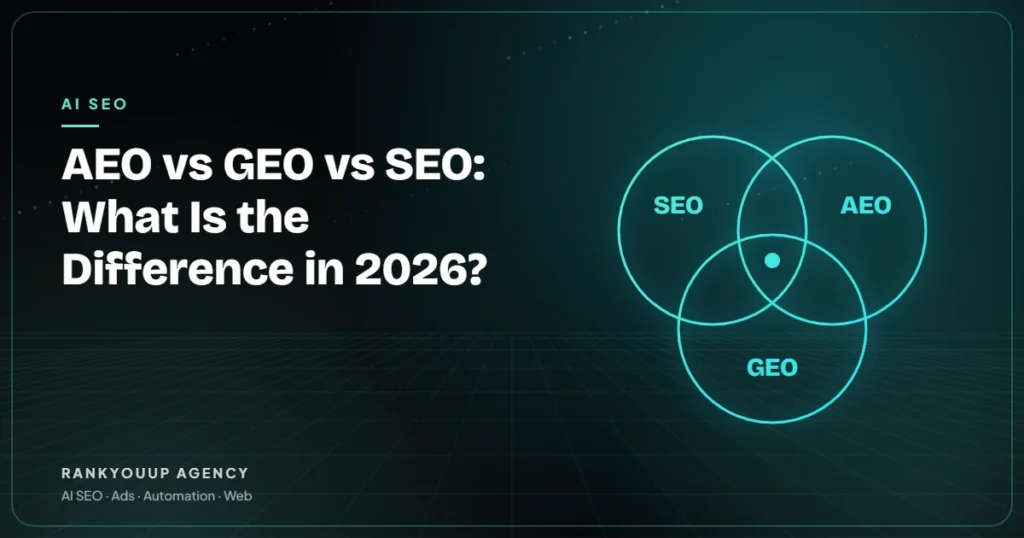 AI SEO
AEO vs GEO vs SEO: What Is the Difference in 2026?
SEO, AEO and GEO are not rivals. They are three layers of the same search strategy. Here is what each…
Read article